
Treatment of disorder
medical treatment


MENU
medical treatment
Angina Pectoris and Cardiac Infarct are the most popular diseases among matured person. They are one of can’t-miss diseases. Especially at acute period hospital treating many emergency patients, most of them are the patient of Angina Pectoris or Cardiac Infarct. We will explain comprehensibly about Angina Pectoris and Cardiac Infarct.
Humans act with thinking. The power source for the activity is a heart. It is like Power generation plant or vehicle engine. Reason why humans can think, exercise, subsist is that heart is supplying enough energy in blood to acting internal organs in a body.
Heart is a pump circulating blood to internal organs of entire body. It supplies relentlessly red blood, received oxygen at lung, to internal organs of entire body. Because no organs will survive when oxygen supply stops. When heart stops beating, the supply of oxygen to entire body also stops. As no oxygen supplied to brain, human falls unconscious. A heart should never and ever stop beating. As explained, heart is a pump keep circulating blood to entire body.

Blood pumped out from heart flows in internal organs of all over entire body with mutually exclusive and collectively exhaustive, then come back to heart. As explained, blood vessel is an organ carrying the circulating blood. Blood amount in a body is consistent, and they are circulating in blood vessels of entire body. They are, therefore, called as circulatory organ for both heart and blood vessel.

Why does heart keep beating? Because red blood, with full of oxygen, is supplied to heart as well. Heart supplies blood to brain, muscle, liver, kidney and others, but it supplies blood to its own muscle to keep beating. A blood vessel which supply blood to heart muscle is called as Coronary Artery.
Coronary Artery comes from nearby position of main artery out from heart, and then it surrounds the heart. There exist a right coronary artery and a left coronary artery. Right coronary artery is positioned below the right ventricle of heart, underneath the left ventricle. Left ventricle is then separated into two branch vessels. Left anterior descending coronary is in front of left ventricle, circumflex branch is at rear of heart’s lateral side. Total three vessels, one right coronary artery, two left coronary arteries, supplies blood to heart equally. When abnormal incident occur at coronary artery, causes not enough power source to heart, it is called as Angina Pectoris or Cardiac Infarct. They are collectively called as Coronary Arterial diseases (CAD).
Heart pumped blood out roughly hundred thousand (100,000) times a day. Therefore, heart needs a fresh, oxygen-full blood all the times. Coronary Artery supplies blood to cardiac muscle becomes narrower or stuck, blood supply to heart comes lessor. It is called as Angina Pectoris, poor circulation of blood in cardiac muscle. However, function of cardiac muscle has not yet diminished entirely at this point. It is like yellow signal turned on. Most people call for chest pain, then will not do any labored exercise. People try to respond to poor circulation of blood with less burden to heart. But in case when stress is applied to heart again, similar chest pain repeats.
In case Coronary Artery stuck further completely, or becomes narrower rather quickly, cardiac muscle is dead, and resulted heart function decline. This is called as Cardiac Pectoris. Cardiac Pectoris appeared suddenly at most case, however there is a case where disease appears unconsciously. Depend upon area and severity of dead cardiac muscles, it is expected for dangerous irregular heart beat or extreme decline of heart functionality, or may cause death in emergency.
 Heart at Cardiac Pectoris or Cardiac Infarct
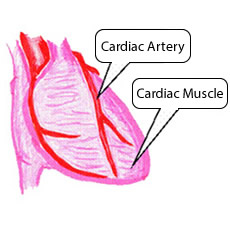 Normal, healthy Heart
As mentioned earlier, Angina Pectoris or Cardiac Infarct occurs when cardiac Artery is getting to stuck or stuck. The main reason for such occurrence is Arterial Sclerosis. Arterial Sclerosis is an abnormal incident for blood vessel. It may occur by, separate from advancing age, diabetes, dyslipidemia, elevated blood pressure, kidney disease, cigarette smoking, lifestyle habit, obesity, and constitution of person. There is a case where walls of coronary artery become gradually narrower by arterial sclerosis, or blood become suddenly hardened then stuck in narrowed coronary artery.
 Arterial Sclerosis of Cardiac Artery
The cause of Angina pectoris is generally arterial sclerosis on coronary artery, but in merely case, it occurs by Variant Angina Pectoris. Unlike coronary artery becomes gradually narrower, it works usually in normal, but coronary artery is suddenly jerked then get narrowed (contraction), then causes symptom of angina pectoris. This is called as variant angina pectoris. Sudden chest pain is a typical symptom. Chest pain may not be caused by physical exercise, but variant angina pectoris causes chest pain just before sleep at night or occurs without having any foretaste. Especially it is being said that variant angina pectoris occurs among young women.
Typical symptom of angina pectoris and cardiac Infarct are listed below.
Most of the people may visit a hospital when chest pains. But it will not the case for all of them are in angina pectoris or cardiac infarct. On the other hand, there is a case that they are unable to visit hospital with the fear for the medical test. At last in taking pains on the chin too much, they must call for ambulance. Else, there is a case in not negligible that if they are hospitalized much earlier, it must not get too bad. But there is a case that arterial sclerosis of coronary artery has advanced without any symptoms so that patient has emergency transported due to sudden chest pain.
Corresponding procedure at medical organization may differ by the symptoms when visiting the hospital.
As the tests for angina pectoris or cardiac infarct, we conduct Electrocardiogram, Chest X-Ray, Blood Test and Coronary Angiography. In case other disease is suspicious, we may apply CT (Computed Tomography)-Test, and Abdominal Ultrasonography Test as well.

Electrocardiogram records an electric signal from beating heart. It is hard to know everything from the record, but there sometimes is a case that Electrocardiogram record shows an abnormality when cardiac muscle has a shortage of oxygen and is accompanied by cardiac infarct.

Although having a chest pain when climbing upstairs or running but with no pain in everyday, there sometimes is a case where Electrocardiogram check at medical check or in still and calm at hospital shows normal waves. In this case, taking certain exercise to apply load to heart may find an abnormality in Electrocardiogram record. Taking Electrocardiogram while exercising, like climbing up or down stairs or peddling a bike, is called Load as Electrocardiogram.
In anyway, electrocardiogram check is a simple test so that it can diagnose whether there is an angina pectoris or cardiac infarct but unable to diagnose where in coronary artery and how severe pathological abnormality occurs are still unknown. This check is best for screening the symptom. Of course there is a case where load electrocardiogram cannot make a decision.

We may ask patient, who have chest pain sometimes or seizure occur in early morning, to take Electrocardiogram for 24 hours. It can analyze 24 hours electrocardiogram changes without hospitalization. Electrocardiogram change at midnight seizure or category and severity of irregular heartbeat can be diagnosed. Although angina pectoris or cardiac infarct is revealed with this test, it becomes a help for diagnosis.

Angina pectoris or cardiac infarct cannot be revealed by Chest X-Ray test. But as same as Electrocardiogram, it is simple and easy test and sometimes very useful. Especially, when the chest pain is not caused by heart, for example caused by lung or costal bones, Chest X-Ray test is very useful. For the heart condition, for example the size of heart or whether lung blood become stasis, can be checked in certain level. We can judge, roughly, the degree of heart debilitation.
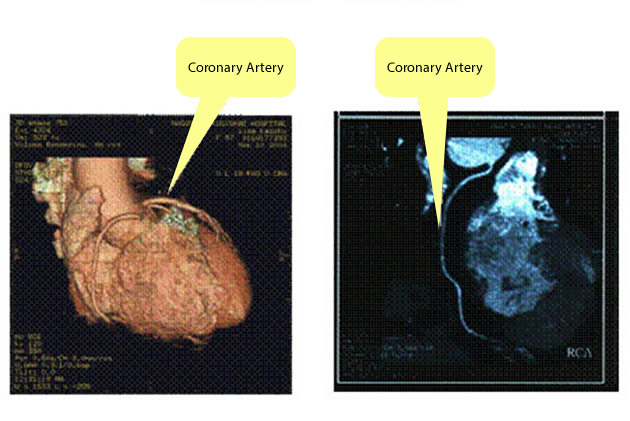 Coronary Artery by 320 row Contrast Enhanced CT

With touching the breast, doctor finds the several things, like shape and movement of heart, shape of heart valve and regurgitation, and if something is compressing heart. In case of cardiac infarct, it can take a hold on the ingravescence in heart movement, like a serious cardiac infarct make a hole in one’s heart, or bleeding from heart.

The cause of angina pectoris or cardiac infarct is an abnormal change of coronary artery so that it is necessary for a final diagnose to check which coronary artery has changed and how seriously ill on coronary artery by coronary artery contrast study. This is the final test and the beginning of medical treatment for Angina Pectoris or cardiac pectoris. Long and thin tube (Catheter) about 2mm diameter is inserted into arteria, moving it to nearby heart, then insert to the entry of coronary artery. Contrast agent is transfused and X-ray it. When the inner cavity of coronary artery is stuck at entry, x-ray photo shows it ends in the middle. Nowadays, it becomes possible to insert the catheter from one’s wrist, resulted the test becomes safe and easy to do in one day.

Medical Exam had not been conducted except for some extraordinary reason in the olden times, but now the exam itself becomes easy and simple to conduct. Medical Exam lasts only for 15 minutes in average, and after the completion of exam, perform astrict on insert point for about three hours, then being released from hospital in a same day. In case of having chest pains, or breath shortness continued so that angina pectoris or cardiac infarct is suspicious in electrocardiogram check, Coronary Artery Contrast Study must be done immediately.

With this exam, which part of coronary artery and how severely stuck, or coronary artery is about to stuck, can be picked up. With knowing the position and severity of pathological abnormality in coronary artery, doctor can grasp the degree and severity of Angina pectoris or cardiac pectoris of the patient. Then in accordance with the result, it is decided that what medical treatment should be done.
There might be a case where Coronary Artery Contrast Study has conducted in suspicious of angina pectoris but unable to find any abnormality. Chest pain can be produced by irregular heart beat (abnormal cardiac rhythm), lung infarction, elevated blood pressure, or else, like gastroesophageal disease, lung disease. Or person who shows no abnormality in any medical exam may rarely exist. Doctor begins the explanation from the point which patient feels comfortable, but if worries are continued, please consult with doctor.
Symptom is a patient’s description. It does not mean that all these descriptions correspond to angina pectoris, or pathological change severity of cardiac infarct, and/or degree of severity. When disease abnormality has progressed chronically and gradually at coronary artery, patients in diabetes or aged individuals likely have no symptom. On the contrary, persons with no symptom have an risk of having sudden cardiac infarct or angina infarct attack, and likely become severe.
There are two major causes for the stuck in Coronary Artery. The one is a case where hardened blood suddenly stuck, i.e. acute cardiac infarction. In this case, stuck blood vessel should be widened by emergency surgical treatment. The other is a case where blood vessel has been gradually stuck from the past, i.e. angina pectoris. There is a case that it is better to start medical treatment as soon as possible depend upon stuck position in coronary artery or severity degree. Of course, angina pectoris or coronary artery are not necessarily possible to judge. We conduct best appropriate medical treatment for each patient while observing every single patient’s, pathological abnormality of coronary artery, heart condition, and overall physicals.
In case of angina pectoris, work or daily life must be limited due to chest pain, but even if one is spending daily life with enough care, there is a case where the burden on heart is unconsciously placed, and in that case chest pain or feeling of oppression is recognized. Even worse is a cardiac episode (cardiac infarct). It is not uncommon story that a person in energy yesterday suddenly fall. Even if the case is without episode, heart is weakened gradually then turns to coexist chronic cardiac failure, abnormal cardiac rhythm, or valve disease. It is recommended that when certain abnormality is noticed, visit the office at earlier as possible.
Several treatment methods can be considered depend on patients condition and degree of pathological abnormality on coronary artery.
The principles of the treatment are:
Particularly, there is drug therapy, catheter treatment (intervention), and surgical treatment.
There is a case where degree of pathological abnormality in coronary artery is minor, or location of pathological abnormality does not affect so much to heart. Medicine used for coronary artery disease is the drug to dilate a coronary artery, to prevent coronary artery from blood being stuck, and to relieve a burden from heart. They are all preventive drugs. There is a drug (Nitro Pens) to take when ictal occur. This is a method as emergency escape, so that it is very dangerous to spend a life with taking Nitro Pens every day. For not bringing Nitro Pens around, it is important to have medical treatment.
This treatment has started 20 years ago. This becomes common treatment because treatment is conducted using small tube so that it gives less burden to patient. Inserting tube to the artery at the base of arm or foot, and making it to reach coronary artery at heart. Then ballooning coronary artery at narrowed inner cavity to broaden the coronary artery. There is a stent treatment which inserts metal net into blood vessel.

 Catheter
 • When balloon is blow-up
 Normal blood vessel
 Blood vessel about to stuck
 Blow hard balloon up in the blood vessel
 Blown-up vessel
A net is thinly collapsed to insert into blood vessel.
When blown up balloon from inside, net in shape remains in the vessel.
Normal Blood VesselBlood vessel about to stuck Blow metal net inside the vessel
 Blown-up vessel with net inserted
Picking up own blood vessel, then bypass stuck coronary artery to make reduced blood stream of coronary artery improved. Bypass vessel, using the internal mammary artery (blood vessel in the back of sternal plate), radial artery (blood vessel at thumb side of forearm), (greater saphenous vein) vein on the foot surface, gastroepiploic artery (blood vessel around stomach), is inosculated to coronary artery on heart. This method is older than catheter surgery, this has used from 30 years ago. Nowadays, it becomes more common method to conduct Off Pump Bypass Surgery to reduce patients’ burden. Catheter surgery is subject to internal medicine surgery but, Coronary Artery Bypass Method is subject to surgery department.
Since Catheter Treatment has less burden to patient, it is recommended to make Catheter Treatment as first preference, if disease can be cured by Catheter Treatment. However, Catheter Treatment has a certain limitation. Nowadays, treatment result of mass patient data from Drug Therapy, Catheter treatment, Surgery cure, becomes unveiled. Based on these result data, treatment guideline for angina pectoris, coronary artery has been published in Japan as well as overseas.
Surgery recommended patient is a person that:
Practically speaking, it is judged from location and degree of pathological abnormality of coronary artery. The selection of Catheter Treatment or Coronary Artery Bypass Surgery are made by attending doctor, to be explained patients, and patients’ family member. There are many cases that are difficult to select Catheter Treatment or Coronary Artery surgery. It is important to decide after consulting with attended doctors’ opinion and explanation. In case if getting confused, it is recommended to have second opinion from another doctor’s comment.
There is a case, depend upon patient clinical condition, where urgent surgery is inevitable, better to have surgery sooner as possible, or having surgery after an interval.
It is reported that the case fatality rate on Coronary Artery Bypass surgery in Japan is 2%, and the same on emergency coronary artery bypass surgery is 11%. There is a case that the patient survives but have a severe complicating disease.

