
Treatment of Disease
Treatment of Disease


MENU
Treatment of Disease
Prostatic Enlargement, as the name suggests, is a disease which prostate is enlarged, and it is said that 1 out of 5 males over 55 of age are affected.
Prostate is the organ that is only in male and located just under the bladder with covering urethral tube around. Therefore, once prostate becomes hypertrophic, it may cause a deleterious effect for the symptom or daily life. Typical symptoms are; “frequent urination”, “hard to produce urine”, or “feeling of residual urine”. True cause of prostatic enlargement is still unknown, but it is at least known that the aging or male hormone do relate to this disease.
Prostatic Enlargement will never evolve toward prostate cancer, but the symptoms are similar so that it is necessary to pay an attention. In case of symptom is mild, it can be followed by chemotherapy but is difficult to have complete cure, and when it becomes hypertrophic, status changes into no urination possible. Hence the insertion of rubber made catheter tube becomes inevitable then it may cause to develop infection disease like infection of the urinary tract accompanied with high fever, or there may be a case of dysfunction of kidneys (uremia) by the occurrence of functional disorder of the kidneys.

To distinguish and diagnose prostatic enlargement, there are; questionnaire to evaluate the subjective symptoms, bladder diary to record urination status, medical examination that puts a finger from the rectum (important for diagnosing prostate cancer), residual urine examination which detects remained urine in the bladder after urination, measurement of urine flow to measure urinary stream, and echography to measure prostate size. Urine test or PSA examination (Blood Test) which is effective for cancer diagnosis also becomes necessary.
It is necessary to have a medical check, with visiting anywhere hospital with urological department. There are many diseases onset disorder of urination prostate available. They are the cancer or other disease other than prostatic enlargement so that it becomes very important to start treatment with distinguishing other diseases.
Treatment is conducted in accordance with Prostatic Enlargement Guideline.
Oral medicine treatment is available but in case where excretion of urine is difficult, surgical treatment becomes necessary. In regard to oral medicine treatment, select medicine in accordance with each symptoms then treatment begins.
As for surgical treatment, endoscope treatment is mainly conducted.
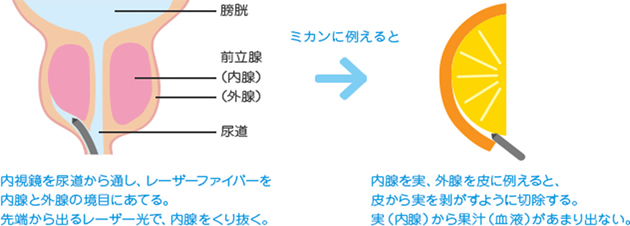

As for the postoperative, process is about the same as transurethral resection of the prostate. Urethral tube catheter is inserted in urethral tube for 2 to 3 days in order to keep wound site at rest. Normally, patient can walk from next day of the surgery. Meals normally start from the dinner on the surgical day.
Also, check the existence of prostate cancer in the hollowed tissue with taking approximately two weeks. Upon finding the result, it is explained.
After decannulation of urethral tube catheter, in case with no fever, status of bloody urine is mild, and when doctor has judged that micturition pain or difficulty in micturition are possibly disappear naturally, patient is discharged from hospital. Normally, it is in 5 to 7 days.
The followings are the list of surgical method other than TUR-P or HoLEP.

